


“She had come dancing up the lane, like a wind-blown sprite, through the mellow sunshine and lazy shadows of the August evening.”
— Anne of Green Gables, L. M. Montgomery, Chapter XXII
This letter may contain affiliate links. As an Amazon Associate I earn from qualifying purchases, at no extra cost to you.
Jump to RecipeYogurt has become a western staple, but it originally comes from Western Asia and the Middle East. Basically, it is milk that has been cultured with Lactobacillus bulgaricus and Streptococcus thermophilus, creating that thick texture. Its bacterial properties are extremely nourishing for our bodies. I like to feed yogurt to my kid to strengthen his body and immune system to fight disease.
A few years ago, I didn’t even know it was possible to make my own yogurt at home. I assumed that it required some special ingredients and equipment. But, once I learned that you can do it in the crock pot in a very hands-off way (literally, just set it and forget it!) I was totally hooked. Store bought is comparatively SO expensive, and you can’t control the sugar and dyes they add to it unless you make your own. I was so used to buying it that I never considered that there was another way.
Homemade yogurt has strong probiotics and is a healthy, inexpensive breakfast item for your whole family. In the absence of sugar and preservatives, homemade yogurt is simply the real thing: just cultured milk. That’s it.
The price of homemade yogurt is the price of a gallon of milk – about $3.25 where I live. A quart is $4.99. So, in order to buy a gallon, it would cost you $19.96. It is more if you buy it in the little disposable cups or squeeze tubes. (Note: if you strain the whey out to make a thicker Greek Style Yogurt, expect the yield to be reduced by half. Instead of 1 gallon of regular yogurt, you will instead yield 1/2 gallon of Greek Yogurt and 1/2 gallon of whey.)
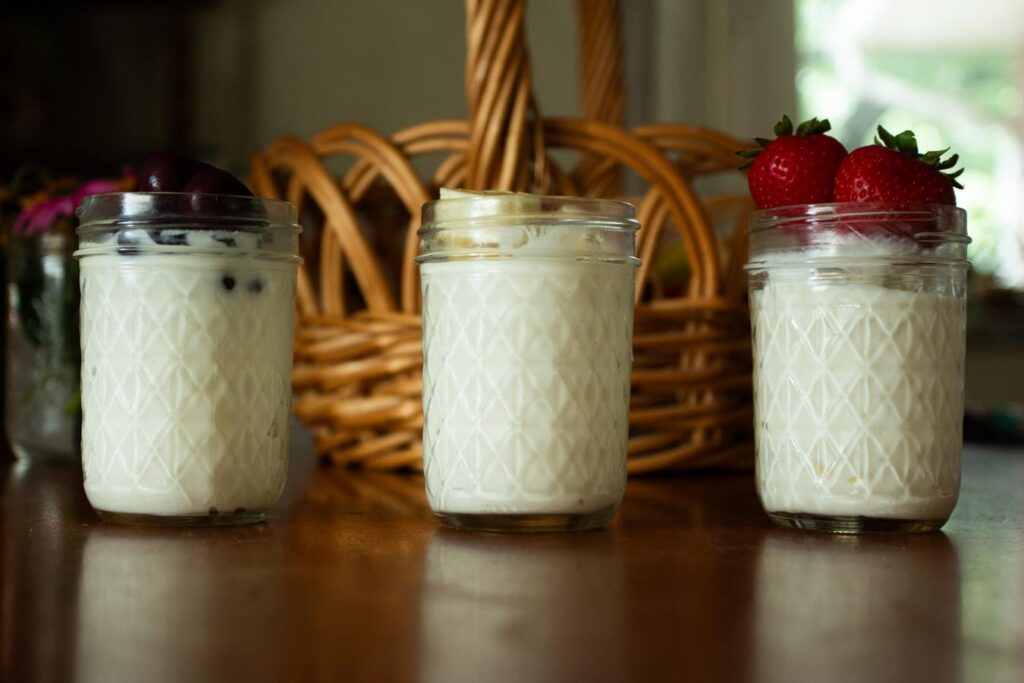
Both healthy and inexpensive to make, homemade yogurt should top your list of simple breakfast items to feed your family.
TIPS
- Make sure your milk has sufficiently heated up and then slightly cooled down again when you add your cultures. It should not be boiling or steaming, but still warm.
- The longer you let it sit, the thicker it will become.
- The liquid on the top is called whey. It is full of protein and is very healthy for people and animals. You can mix it in or strain it out through a cloth into a bowl. If you choose to strain it, you can feed it to your dogs or save it to add to a smoothie or a recipe. I often use whey instead of water when I am baking sourdough bread.
- Homemade yogurt keeps in the fridge in a Mason jar for several weeks. (I use the half gallon jars with the wide mouth airtight plastic lids from Mason Tops.)
FAQ:
Why make yogurt at home?
Homemade yogurt is made from two ingredients: whole milk and live cultures (often from previously made). Because it is purely cultured milk with no preservatives or sweeteners, it is easier on your digestive system. You can add your own fruit or sweetener to your liking, but homemade as a base is healthier than store bought .
What is the benefit of making your own yogurt?
There are two reasons making your own yogurt is beneficial: 1) It is much cheaper to make than it is to buy it. It is more than 75% off the cost of store bought.
Homemade yogurt is healthier as well, containing billions of probiotics and zero preservatives and sweeteners.
Is homemade yogurt healthier than store bought?
Store bought yogurts often contain corn starch, food coloring/dye, “natural flavors,” and other preservatives. Homemade yogurt is only cultured milk, nothing else, making it a much healthier choice. The probiotics are greater in homemade, so it has a more positive impact on your immune system.
Does homemade yogurt have enough probiotics?
Homemade yogurt can have up to 700 billion CFUs of good bacteria by the 24 hour mark (if you let it ferment that long). Homemade is not lacking in probiotics unless it is heated up to kill them, or if you leave it out too long.
Does homemade yogurt get thicker the longer it ferments?
Homemade yogurt does get thicker the longer it ferments – but only up to 24 hours or so. (Give or take). When the cultures run out of food and begin to die, it will cease becoming thicker and begin to die.
Why didn’t my crock pot yogurt thicken? Why is it soupy?
There is nothing more disappointing than checking on your homemade yogurt… and nothing happened. It has happened to me before! Here are a couple of reasons this could have occurred:
- The milk did not reach scalding temperature (180 F) and the cultures did not take.
- The milk was too hot when the cultures were added, and it killed them.
- The cultures were not live to begin with.
I have saved yogurt when this happens by putting it in a 100 F oven for a few hours and coaxing it up to congealment. However, this method will not be possible if your cultures are dead.

Why do you boil milk for yogurt?
When your milk reaches 180 F, it kills foreign bacteria that is prohibiting the growth of the CFUs. This is a necessary step to ensure that the yogurt will set correctly. However, it should not boil – that is too hot.
What is the best milk to make yogurt with?
Yogurt can be made with many different types of milk, but the most creamy yogurt is made from whole milk. You can use 1% or 2% milk, but the level of CFUs and protein will be less than if you use whole milk.
Is runny homemade yogurt safe?
There is a normal watery liquid substance in all yogurt (even store bought) called whey. However, if it is runny like plain milk, that is an indication that it is not done, or that the cultures were compromised. As long as it has not spoiled, it should be safe, but it will not be the texture you are looking for.
What happens if you overcook your mixture when making yogurt?
If you overcook it, the milk will curdle like cheese. This has happened to me before. Once this happens, there is no way to turn it back into yogurt.
What is the best way to make thick yogurt?
Thick yogurt, such as Greek yogurt, has the whey strained out of it. In order to make a thick yogurt, you will need to strain it through a cloth.
What makes yogurt thick?
The protein is what makes yogurt thick. This is why you use a whole milk instead of a skim or 1%-2% milk. The higher protein will make a stronger, thicker yogurt.
Is it cheaper to make your own yogurt?
Homemade yogurt is about 1/4 the cost of store bought. In my region at the time of writing this, a gallon of milk is about $3.25, and a quart of store bought yogurt is $4.99.
What happens if you use too much yogurt starter?
If you use too much starter yogurt, your yogurt may turn out thicker. It is better to use too much than too little. Not enough starter will produce thin, runny yogurt like milk.
How long will homemade yogurt last?
Homemade yogurt will last 2 weeks to a month in the refrigerator. Keep it in a Mason jar with an airlock lid so it will stay fresh longer.
Can you make homemade yogurt in an Instant pot?
You can absolutely make homemade yogurt in an Instant pot! Many of them come with a simple “yogurt” button so it will work the magic on its own. My Instant Pot does not have a yogurt button, and I have found it simple enough to do in the crock pot/slow cooker that I do not feel that I need the Instant Pot with the yogurt feature. But, it is totally doable, and many people make yogurt this way.
Do I need a special yogurt maker to make homemade yogurt?
You can buy a number of homemade yogurt makers on the market. Many people use them and find them helpful! However, I have never used one. I have only used a crock pot, and I recommend it because it is so simple. There are a number of ways to make yogurt, though, and you may find a different option that you like best.
Do I have to buy store bought yogurt with live cultures in order to make yogurt at home?
You can save yogurt from your previous batch to make yogurt again. It does not have to come from the store. However, the important part is that it has strong active live cultures.
How long can I incubate the yogurt?
The standard amount of time for yogurt incubation is 12 to 24 hours after adding the live cultures. The live cultures are eating the milk and reproducing as cultured dairy, which is how we get yogurt! However, after 36+ hours, the live cultures will run out of food in the milk and begin to die. This is when the yogurt begins to go bad and becomes inedible. You will know if it is good if it is white with a clearish-yellowish whey liquid and smells tangy. If it becomes discolored in any way (especially if it develops spots of pink or black), it has run out of food and is beginning to die. This is when you should throw it out and not eat it.
Does homemade yogurt taste as good as store bought?
Homemade yogurt is creamier, slightly sour (some might say it is “tangy”) than store bought yogurt. The biggest flavor in store bought yogurt that is lacking in homemade is the sweetness, at least when you first make it plain. If you add your own fruit and sweetener, it becomes a delicious sweet treat.
How much yogurt should I eat in a day?
A cup of yogurt every day to increase your gut health is very good for you! It supports your digestive system, immune system, weight management, liver, and so many other things. (Note: I am not a doctor, so consult your doctor to see what foods are best for you.)
My yogurt did not set. What now?
I have saved failed yogurt before. Simply start over. Heat it up, add cultures, and try again. If it still does not work, the cultures in your starter may be dead.
What does it mean if a dairy product has been cultured?
Cultured dairy, such as cottage cheese, sour cream, yogurt, kefir, and different types of cheese, have been safely fermented with bacteria to create different end products.
Can you make other dairy products at home?
You can easily make ice cream, butter, yogurt, whipped cream, sour cream, cream cheese, ricotta cheese, milk kefir, a simple soft farm cheese, mozzarella cheese,and many other dairy products at home. Some more complicated ones include cheddar cheese and asiago cheese, but it is totally doable. You can learn how to make any dairy product at home. If you have access to fresh milk, you are probably looking for a variety of ways to use up all of it. However, you can make these things with regular store bought milk and the appropriate live cultures, depending on the recipe.
HOW TO MAKE YOGURT:
- Whole milk (Organic or fresh-as-possible is your best option, but any milk will work.)
- A small tub of plain yogurt with live cultures (I have been known to throw a whole quart in. You can add more than an individual serving, but not less.) This is your yogurt starter.
TOOLS
- 1 slow cooker that holds at least 1 gallon of liquid (Mine was thrifted, but I have linked the same brand. The color that I have does not appear to be available anymore.)
- 1 Spatula
- 2 Half gallon Mason jars or airtight container
- 1 wide mouth funnel for pouring into the Mason jar (optional)
- 1 food thermometer (optional)
- Strain through a cloth (if making Greek yogurt)
- 1 colander
- 1 large bowl
INSTRUCTIONS
- Pour gallon of milk into the slow cooker.
- Heat on low for 3 hours. It should reach a temperature of about 180 F.
- Allow to cool for at least 2 hours, but don’t let it return to room temperature. It should still be warm, about 110 F.
- Add the yogurt cultures – a minimum of 1/2 cup of finished yogurt.
- Allow it to sit unplugged for a minimum of 12 hours and up to 24 hours. A longer ferment will result in a thicker, more tangy yogurt. It will produce a liquid on top called whey.
- If you do not want to make Greek yogurt, stir to incorporate the clear liquid back into the yogurt and add to your airtight storage containers.
- If you would like to make Greek yogurt out of your homemade yogurt, line a colander with cheesecloth or a flour sack towel. Place the colander in a large mixing bowl.
- Slowly spoon the yogurt into the cloth. Allow the whey to filter through the cheesecloth and into the bowl.
- Add the yogurt to two half gallon Mason jars or airtight containers. Enjoy your fresh yogurt!
Slow Cooker Yogurt Recipe
Equipment
- 1 slow cooker that holds at least 1 gallon of liquid
- 1 Spatula
- 2 Half gallon Mason jars or airtight container
- 1 wide mouth funnel for pouring into the Mason jar optional
- 1 food thermometer optional
- 1 straining cloth optional
- 1 colander
- 1 large bowl
Ingredients
- 1 Gallon Whole Milk
- 1/2 C. Plain finished yogurt with live cultures (this can come from the store, or it can be leftover from your previous batch of yogurt.)
Instructions
- Pour gallon of milk into the slow cooker.
- Heat on low for 3 hours. It should reach a temperature of about 180 F.
- Allow to cool for at least 2 hours, but don't let it return to room temperature. It should still be warm, about 110 F.
- Add the yogurt cultures – a minimum of 1/2 cup of finished yogurt.
- Allow it to sit unplugged for a minimum of 12 hours and up to 24 hours. A longer ferment will result in a thicker, more tangy yogurt. It will produce a liquid on top called whey.
- If you do not want to make Greek yogurt, stir to incorporate the clear liquid back into the yogurt and add to your airtight storage containers.
- If you would like to make Greek yogurt out of your homemade yogurt, line a colander with cheesecloth or a flour sack towel. Place the colander in a large mixing bowl.
- Slowly spoon the yogurt into the cloth. Allow the whey to filter through the cheesecloth and into the bowl.
- Add the yogurt to two half gallon Mason jars or airtight containers. Enjoy your fresh yogurt!
Notes
USES FOR THE STRAINED WHEY
- Feed to a dog or farm animals.
- Add to a smoothie.
- Use in place of water in sourdough bread recipe.
- Use in place of water in oatmeal.
- Use in place of water in pasta.
- Add to mashed potatoes.
- Add to soup and homemade stock.
- Dilute and add to your garden.
- Wash your face with it to balance the ph on your skin.
- Use in your lacto-fermentation, such as sauerkraut and fermented salsa.
- Use in any recipe in place of water or milk. However, the more whey is heated up, the more it loses its live properties.
- Make whey ice cubes to use in cooking later.
- Make whey salad dressing, which can also be used as a marinade.
- Add to your compost bin. This is not my preferred method because I would like to use the whey. But, it will nourish your soil that way.
- Dilute it to diminish the strong flavor and drink it!
- Make a whey based lemonade or cultured ginger beer.
HOW TO SERVE
Since it is a plain unsweetened yogurt, you will need to add your own flavor. Here are a few ways you can serve this yogurt:
- Mix with fresh or frozen fruit to-serve
- Blend into a smoothie
- Mix with a spoon full of vanilla extract and sweetener (maple syrup, turbinado sugar, honey, etc.)
- Blend into a recipe where you would normally use milk or sour cream, such as mashed potatoes or pancakes.
- Make overnight oats with yogurt.
- Make Yogurt popsicles.
- Try a frozen yogurt recipe in your ice cream maker.
- Make homemade pudding with yogurt as the base.
- Add maple syrup and vanilla and eat with a spoon.
- Mix with fresh strawberries, raspberries, blackberries, or blueberries in-season.
- Mix with jam or jelly.
- Try coconut flakes or toasted almonds in your yogurt.
- Play with spices, such as cinnamon, ginger, cardamom, and nutmeg.
- There are more sweeteners than sugar! Try maple syrup, honey, turbinado sugar, coconut sugar, a TEENY bit of molasses, or stevia to add sweetness to your yogurt.
- Tropical yogurt blend: Add pineapple, mango, and chopped kiwi.
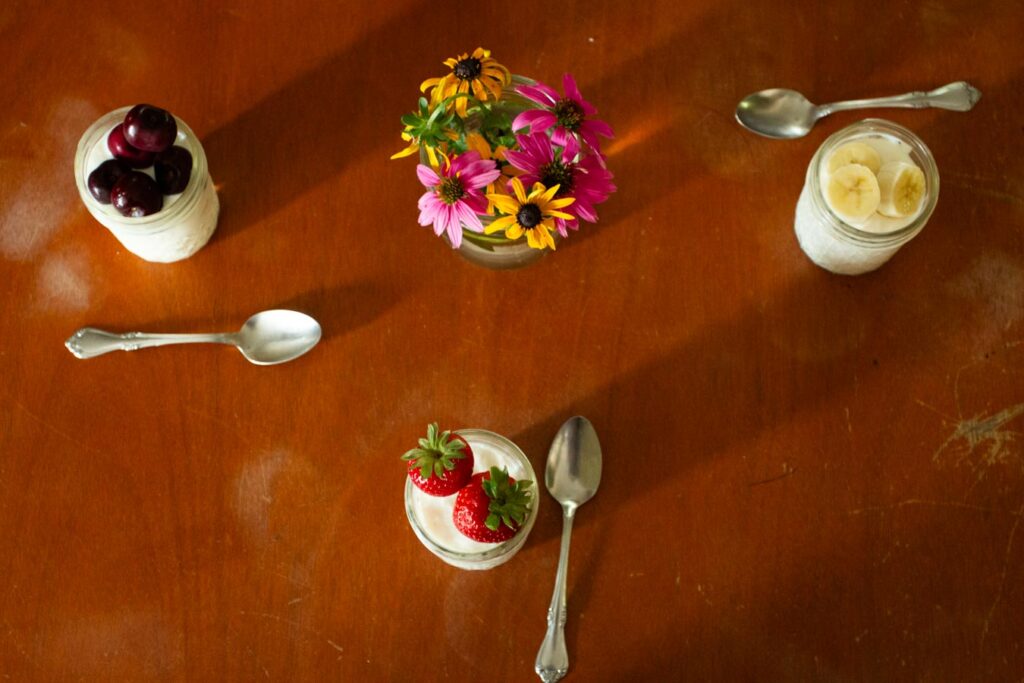
- Summer blend: Add fresh or frozen cherries in season.
- Autumn blend: Add apple butter, cinnamon, and a dash or pumpkin pie spice.
- Winter blend: mix with canned Morello cherries or canned fruit from the summer.
- Spring blend: mix with strawberries and chopped banana.
- Add chopped strawberries and kiwi.
- Make a parfait with homemade granola.
- Make a banana pudding with homemade yogurt as the base, and serve with graham crackers or vanilla cookies.

YOU MAY ALSO ENJOY…
- Summer Fika Break + Homestead Coffee Recipe – As I have been learning about homesteading, slow living, and being conscious about our health choices, I learned about something else that goes hand in hand with all of those things: Fika. The root of all of these things is to shed the cloak of “treadmill style” obligations, to slow down and look life in the eye, and to focus on work that is truly meaningful.
- Homemade Vanilla Ice Cream – Who doesn’t have memories of chasing an ice cream truck, racing the sun to finish an ice cream cone before it melted, or watching their grandfather turn the hand crank on an old fashioned ice cream maker? (Or, breaking up the bag of rock salt in the driveway in preparation for making ice cream!) Ice cream has so much summer delight, I just had to try making it.
- Creamy Iced Green Tea Recipe – Tea is such an underrated drink. I am going to show you today how to make a yummy, creamy iced tea using Green Tea. Many people only drink Tea when they are sick, or they enjoy a tall glass of Carolina sweet tea in the summer. (Not knocking either of those things at all!) But you know you have found a fellow tea lover when they have a collection of the greens, whites, reds, blacks, oolongs, herbals, fruits, and darjeelings. Those of us who love tea, REALLY love tea. (Who else carries a small container of tea bags in their purse? Just me?)
- Why I’m Not a Minimalist – When you are a busy mom, clutter just creeps in and takes over your life when you aren’t looking. Jackets, shoes, umbrellas, papers, it all piles up. Watching one episode of Hoarders is enough to make you want to get rid of everything you own until your possessions are pared down to exactly two forks and a sofa. (And I have heard minimalists argue to get rid of the sofa.) It is tempting to haul everything to the curb and start over with a clean slate of beige.
- Homemade Whipped Cream Recipe – When you have a busy schedule, making your own whipped cream feels so “extra.” (As if Whipped Cream isn’t always extra!) But let me tell you, that this is not the case. This is a very easy recipe. It is such a treat to keep on hand or to make fresh, and it doesn’t take a lot of extra time. Young children especially really dig watching the liquid cream turn into soft peaks.




2 Comments